Robotics Guide
Goods-to-Person vs. Person-to-Goods: Which Model Fits?
Jul 26, 2026 · 15 min read · Robotech Pros
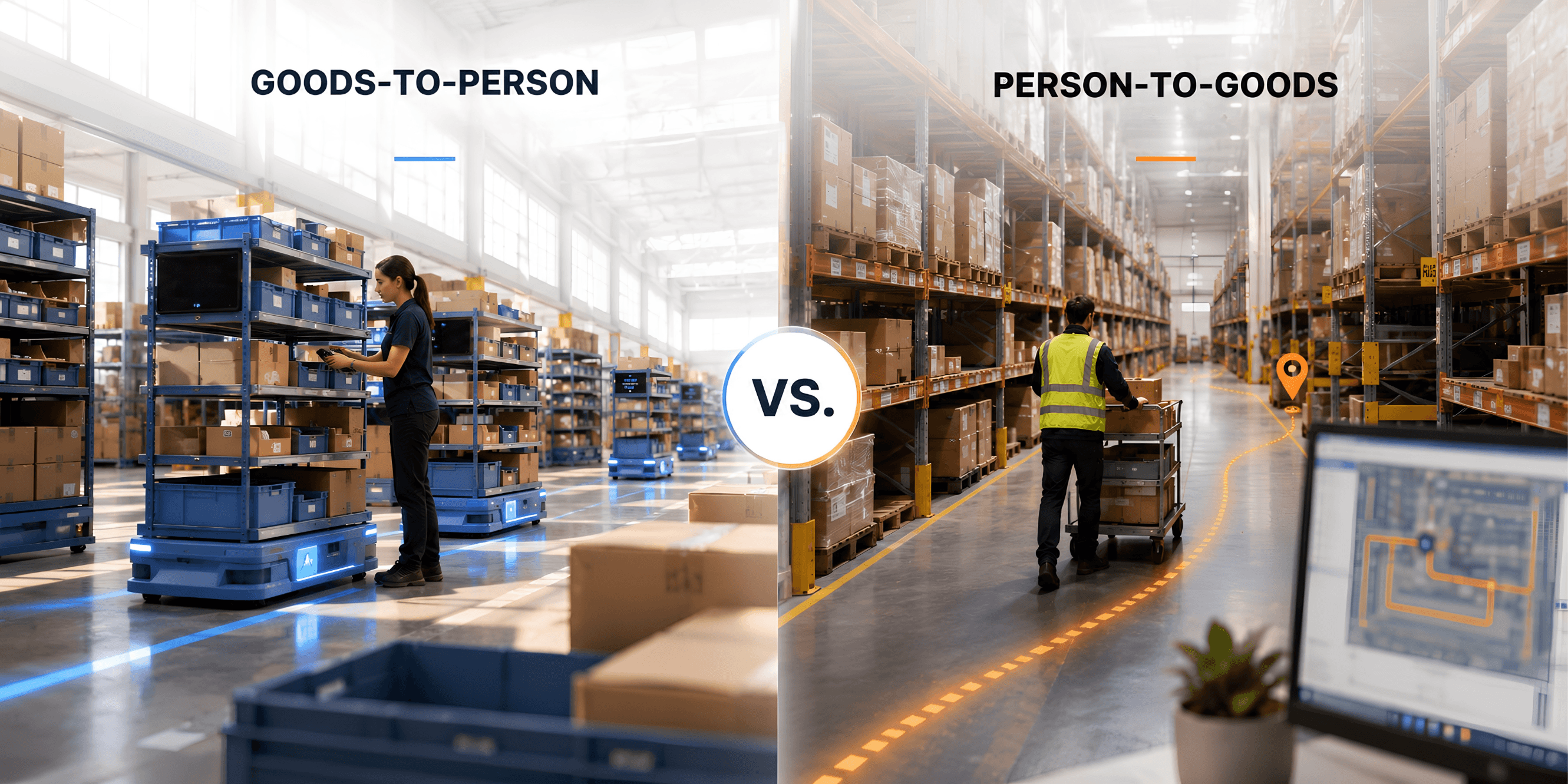
Compare goods-to-person and person-to-goods fulfillment on throughput, cost, density, and flexibility, and see which model fits your warehouse.
Goods-to-Person vs. Person-to-Goods: Which Fulfillment Model Fits Your Warehouse?
Every warehouse picks orders one of two ways. Either the person travels to the inventory, or the inventory travels to the person. The robots, the software, the storage grid, and the conveyor are all implementation details layered on top of that single choice.
That is why the goods-to-person versus person-to-goods question deserves to be settled before the first vendor demo. Teams that select hardware first usually end up reshaping their workflow around a system they already bought, instead of choosing a system that matches how their orders actually behave.
The realistic answer for most facilities is not one model or the other. It is a deliberate split, with fast-moving inventory handled by an automated goods-to-person subsystem and the long tail picked by people on the floor. Getting that split right is where the operational and financial difference shows up.
What Each Model Actually Means
Person-to-Goods (PTG)
In a person-to-goods operation, the picker moves to the storage location. This covers discrete order picking with paper or RF scanners, batch and cluster cart picking, zone picking with conveyor handoffs, and robot-assisted picking where a mobile robot meets the picker and carries the totes. Robot-assisted picking is often marketed in a way that blurs the line, so it is worth being precise. If the person still walks to the shelf, it is a person-to-goods operation with better travel optimization and less cart pushing. That is a genuine improvement in the right facility, and it is not the same thing as goods-to-person. The distinction matters because the two approaches have very different capital profiles and very different failure modes. Our breakdown of what autonomous mobile robots can and cannot do covers where that assist model holds up.
Goods-to-Person (GTP)
In a goods-to-person system, inventory is presented to a stationary operator by robots, shuttles, or a dense storage grid. The operator stays at a workstation, picks from a presented bin into an order container, and confirms the pick by light or screen. Walking is removed from the job entirely, and the operator can be productive within an hour of training.
Table 1: Goods-to-Person vs. Person-to-Goods at a Glance
| Operational Factor | Person-to-Goods | Goods-to-Person |
|---|---|---|
| Picker travel | Roughly half of picker time, higher in poorly slotted facilities | Effectively eliminated; operator stays at the station |
| Typical lines per hour, per operator | 60 to 150 depending on method and layout | 200 to 600 or more per station, depending on system type |
| Storage density | Constrained by aisle access requirements | Commonly 2 to 4 times conventional shelving |
| Pick accuracy | Typically 99.0 to 99.7 percent with RF scanning | Typically 99.9 percent or better with light-directed confirmation |
| Peak flexibility | Scale by adding people, shifts, and carts | Capped by station and robot count; scaled by design, not by hiring |
| Item suitability | Handles any size, weight, or shape | Best for small to medium items that fit totes or bins |
| Primary failure mode | One picker slows down; the operation continues | System downtime can halt a zone and lock inventory inside it |
| Operator training time | Days to weeks to build facility familiarity | Under an hour for a station operator |
Where the Real Difference Shows Up: Travel Time
Walking is the single largest consumer of labor time in a manual picking operation. Industry studies have put unproductive travel at roughly half of total order-picking time for decades, and in large facilities with poor slotting discipline it runs higher. A picker in a big distribution center can cover eight to twelve miles in a shift, and none of those miles add value to the order.
Goods-to-person removes that cost. The trade is that the constraint moves. Instead of being limited by how fast people walk, throughput becomes limited by how many workstations you have, how many robots are in the fleet, and how intelligently the software sequences and batches work.
This is the point most evaluations miss. GTP performance is a design output, not a purchase. Two facilities running identical hardware can differ by 30 percent in effective throughput based on slotting logic, order batching rules, and how bins are consolidated at the station. The hardware sets the ceiling. The software and the workflow decide how close you get to it.
Density and Floor Space: The Quietly Decisive Factor
Throughput gets the attention, but density is often what makes the financial case. Person-to-goods requires aisles wide enough for people, carts, and equipment, and those aisles consume a large share of usable floor area. Goods-to-person systems compress or eliminate aisles, which is why they commonly achieve two to four times the storage density of conventional shelving in the same footprint.
The value of that density depends entirely on local real estate economics. In markets where industrial space is expensive and scarce, avoiding a facility expansion or a second lease can outweigh the labor savings in the business case. In lower-cost markets with room to grow, density is a nice-to-have and the case has to stand on labor and throughput alone. This is a large part of why the same system produces very different payback periods in different regions.
Vertical space matters here too. Cube-based and shuttle systems convert clear height into storage capacity in a way manual shelving cannot, so a facility with 32 feet of clear height has a materially stronger goods-to-person case than an older building with 22 feet and low sprinkler placement.
The Goods-to-Person Options Are Not Interchangeable
Treating GTP as a single category leads to poor comparisons. The four common architectures behave differently on density, throughput, item tolerance, and building requirements. Mobile robot pod systems are the most forgiving to install and the easiest to expand incrementally. Cube-based grids deliver the highest density per square foot but are the least tolerant of item variation. Shuttle systems deliver the most consistent high throughput but demand the most structural commitment. Carousels and vertical lift modules solve a narrower problem well and should not be evaluated against the other three on throughput terms.
Table 2: The Main Goods-to-Person System Types Compared
| System Type | How It Works | Strongest Fit | Main Constraint |
|---|---|---|---|
| Mobile robot pod GTP | Robots lift and carry movable shelving units to fixed pick stations | High SKU counts, e-commerce piece picking, operations expecting growth | Needs level floors and clear robot travel space; lower density than grid systems |
| Cube-based AS/RS (grid storage) | Robots travel on top of a stacked bin grid and deliver bins to ports | Small items, urban facilities, tight footprints, high land cost | Poor fit for bulky or heavy items; bin digging slows access to buried inventory |
| Multi-level shuttle AS/RS | Shuttles retrieve totes on each level and feed workstations by conveyor | High and steady throughput with predictable order profiles | Highest capital and structural demands; least layout flexibility once built |
| Carousels and vertical lift modules | Rotating or vertical trays present inventory at an access window | Small parts, spare parts, tool cribs, low to moderate volume | Throughput per unit is limited; scaling means buying more machines |
Cost, Throughput, and the Payback Question
Capital is where the two models separate most sharply. Person-to-goods is cheap to start and expensive to run at volume, because labor cost scales almost linearly with order growth. Goods-to-person is expensive to start and cheap to run, provided the volume that justified it actually materializes. That conditional is the whole risk. Before committing, work through the numbers properly using a structured approach to warehouse automation ROI.
Table 3: Indicative Investment and Performance Profile
| Model | Indicative Capital Range | Deployment Timeline | Payback Considerations |
|---|---|---|---|
| Manual PTG (shelving, carts, RF) | Under 250,000 dollars for a mid-size zone | Weeks | Minimal capital exposure, but labor cost rises in step with volume |
| Robot-assisted PTG | Roughly 500,000 to 2 million dollars for a 10 to 25 robot fleet, or monthly under a service model | 8 to 16 weeks | Often 12 to 30 months where walk distances are long and volume is steady |
| Mobile robot pod GTP | Roughly 2 to 10 million dollars and up | 6 to 12 months | Commonly 3 to 5 years, highly sensitive to volume stability |
| Cube or shuttle AS/RS GTP | Roughly 3 to 15 million dollars and up | 9 to 18 months | Commonly 4 to 7 years, improved where saved floor space has real estate value |
These ranges are planning brackets for scoping conversations, not quotations. Real numbers move significantly based on facility condition, throughput targets, software integration scope, redundancy requirements, and whether the system is purchased outright or subscribed to under a service model.
When Person-to-Goods Is Still the Right Answer
Automation vendors rarely lead with this, but there are facilities where person-to-goods remains the correct operational and financial decision. Low or highly unstable order volume is the clearest case. So are catalogs dominated by bulky, heavy, or irregular items that no bin or tote will hold, and buildings with uneven floors, limited clearance, or constrained power.
Lease tenure is the factor teams overlook most often. If a goods-to-person system carries a four to seven year payback and the facility has three years left on its lease, the math does not work unless the system is genuinely relocatable and the relocation cost is in the model.
There is also a sequencing argument. Many operations can recover 15 to 30 percent of picking productivity through better slotting, tighter batching, and layout changes before any hardware is purchased. Automating an inefficient workflow simply locks the inefficiency in place at higher cost, which is one of the recurring themes in what warehouse leaders underestimate about robotics deployment.
The Hybrid Model Most Facilities Actually Land On
In practice, the strongest performing operations are not purely one model. They segment inventory by velocity and item profile, then apply the right model to each segment. Fast-moving items that fit totes go into the goods-to-person subsystem, where density and pick rate pay off. The slow-moving long tail, the oversized items, and the awkward shapes stay with people on the floor, often with robot assistance to cut the walking.
The design detail that decides whether a hybrid works is order consolidation. Multi-line orders that span both subsystems need a defined merge point, a container strategy, and a WMS that can hold partial orders without losing priority. Hybrid deployments that fail almost always fail here rather than at the robot layer.
For 3PL and logistics operators, the hybrid approach is often the only defensible starting point. Client contracts turn over, SKU profiles change with each new account, and committing a whole facility to a fixed GTP footprint creates exposure that a shared or modular design avoids.
How to Decide
The decision is rarely close once the operating data is on the table. The following factors carry the most weight in a real assessment.
Table 4: Fit Assessment for Goods-to-Person Investment
| Decision Factor | Points Toward Goods-to-Person | Points Toward Person-to-Goods |
|---|---|---|
| Daily order lines | Consistently high and trending upward | Low, sharply seasonal, or unpredictable |
| Item profile | Small to medium items that fit totes or bins | Bulky, heavy, irregular, or oversized items |
| Order profile | Many small orders with few lines each | Fewer, larger orders with broad line spreads |
| SKU velocity spread | A clear fast-moving core drives most lines | Flat demand spread across a long tail |
| Facility tenure | Owned, or five or more years remaining on the lease | Short remaining lease with relocation likely |
| Labor conditions | Chronic hiring difficulty, high turnover, rising wage pressure | Stable, available, and affordable labor pool |
| Building condition | Level floors, adequate clearance and power capacity | Uneven floors, low clearance, constrained power |
| Software maturity | WMS can expose real-time order priority and inventory state | Legacy WMS with limited integration capability |
| Workflow discipline | Slotting and batching already optimized | Meaningful gains still available without capital spend |
A useful sequence is to work through these in order rather than in parallel. Confirm the item and order profile first, because that alone rules goods-to-person in or out for a large share of facilities. Then test volume stability against the payback window, not against a best-case forecast. Only after those two checks pass does it make sense to compare specific architectures or invite vendors to quote. Running the comparison in the opposite direction, starting from a demo and working backward, is how facilities end up with capable systems that do not fit their orders.
How Robotech Pros Approaches the Decision
Robotech Pros works with fulfillment operators, 3PLs, and manufacturers to answer this question with operating data rather than vendor literature. That means auditing current pick paths and travel time, segmenting SKUs by velocity and dimension, modeling throughput against realistic peak scenarios, and validating what the existing WMS can support. Where the case for goods-to-person holds up, we recommend proving it in one zone before it becomes a facility-wide capital program. If you want a grounded read on which model fits your operation, start with a free assessment.
Related resources
How Many AMRs Do You Actually Need? A Guide to Throughput Modeling
Most AMR fleet sizes are guessed before anyone counts the moves. This guide walks through the four-step throughput model that replaces the guess, and explains why doubling throughput takes more than double the robots.
Robot Charging Infrastructure: Battery Strategy, Opportunity Charging, and Floor Space Planning
Charging is usually treated as an electrical question and handed to an electrician. The harder question is how much productive floor space the dock bank consumes, and how much of the fleet sits parked when throughput pea
How Racking, Aisle Widths, and Mezzanines Limit Your Automation Options
Most automation shortlists are decided by the building, not the vendor. A practical look at how rack configuration, clear aisle width, and mezzanine design rule options in or out, and what to measure before you invite an