Warehouse Automation
Warehouse Automation for 3PLs: What Works, What Doesn't, and What to Watch Out For
Jun 4, 2026 · 17 min read · Robotech Pros
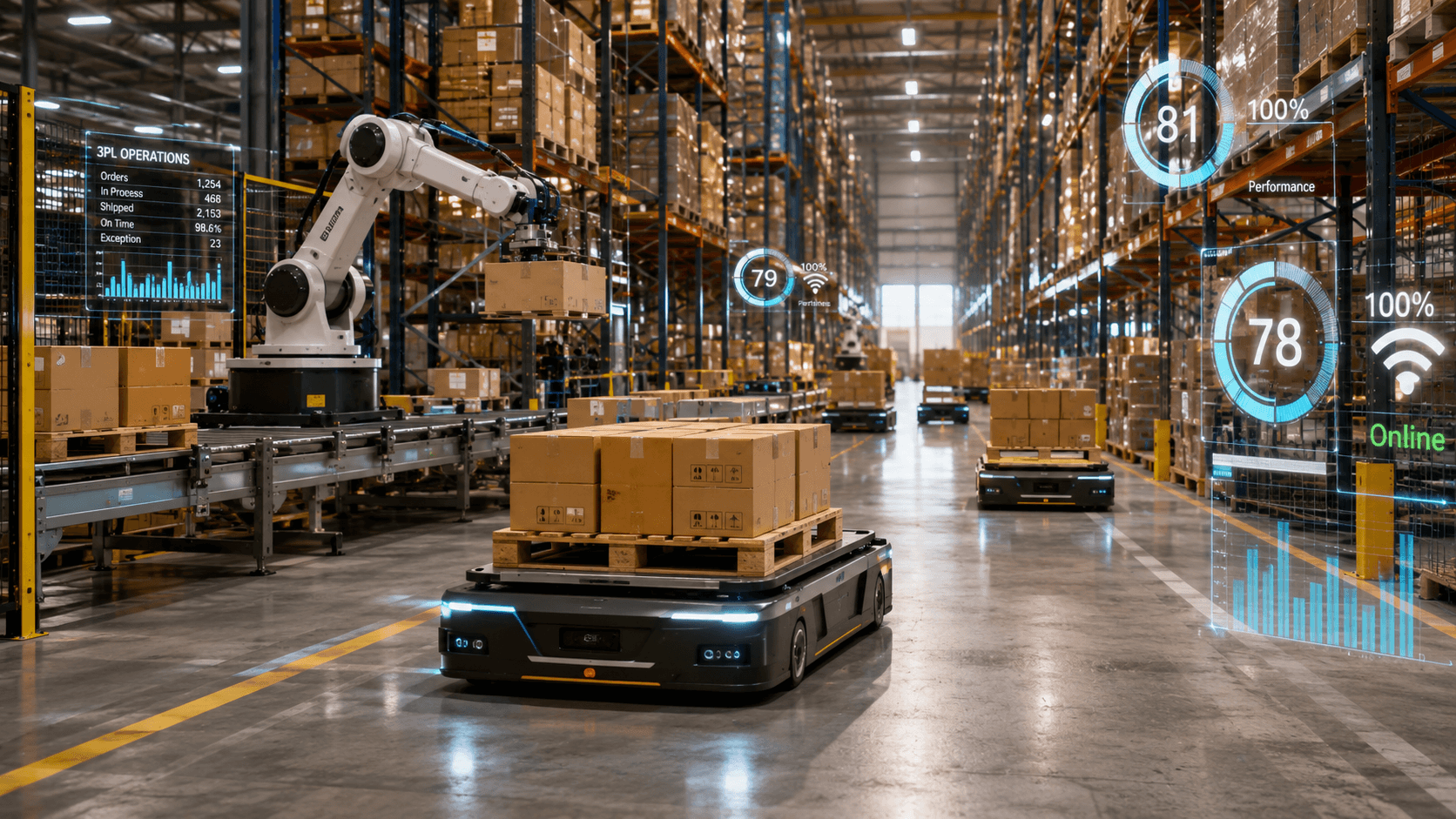
Warehouse automation can transform 3PL operations, but not every solution delivers results. Learn what works, what doesn’t, and how to avoid costly deployment mistakes.
Warehouse automation looks straightforward in a vendor demonstration. A robot moves confidently through clean aisles, picks an item without hesitation, and routes it perfectly to the outbound dock. The numbers on the screen show impressive throughput gains. The conversation turns optimistic.
For a dedicated retail or e-commerce fulfillment operation, that picture may be reasonably accurate. For a third-party logistics provider, it is often incomplete.
3PLs operate under a set of constraints that most automation vendors do not fully address upfront. Multi-client environments, variable SKU profiles, short contract durations, and fragmented technology stacks create challenges that a standard deployment playbook was not designed to handle. Some automation investments perform exceptionally well in this context. Others create as many problems as they solve.
This article covers what actually works in 3PL warehouse automation, where common systems fall short, and what every operations leader should evaluate carefully before committing to a deployment.
Why 3PLs Face Different Automation Challenges Than Dedicated Warehouses
Most automation case studies you will find online describe single-client fulfillment centers: one brand, one product catalog, one operational model. Those environments are relatively stable. The SKUs are known. The workflows are consistent. The automation system can be configured once and run at scale.
A 3PL does not have that luxury. A mid-sized 3PL might manage 10 to 30 clients under one roof, each with different packaging formats, order profiles, returns processes, and service level expectations. Client mix changes over the year. A new client onboards with a completely different product range. A seasonal spike doubles volume from one client while another winds down.
This variability fundamentally changes the automation equation. The question is not just whether a system works. It is whether it works across a constantly shifting operational environment without requiring a full reconfiguration every few months.
The 3PLs that get automation right tend to approach it differently. They are selective about which workflows they automate, deliberate about technology choices, and realistic about the operational conditions those systems must handle.
What Actually Works in 3PL Warehouse Automation
Not all automation is equal, and not every system that performs well in a manufacturer's warehouse will perform well in a 3PL. The technologies that consistently deliver results share a common trait: they handle volume and variability without requiring heavy reconfiguration.
Automation Technologies That Perform Well in 3PL Operations
| Technology | Best Fit in 3PL Operations | Why It Delivers Results |
|---|---|---|
| Autonomous Mobile Robots (AMRs) | High-volume goods transport across large floor footprints | Flexible navigation adapts to changing layouts; no fixed infrastructure required |
| Automated Sortation Systems | Parcel returns, cross-docking, and outbound sortation lanes | Handles high throughput with consistent accuracy; effective across mixed client parcels |
| Goods-to-Person (GTP) Systems | Pick-dense fulfillment operations with stable SKU profiles | Reduces picker travel time significantly; strong ROI in high-order-volume environments |
| Robotic Picking Arms | Carton-level picking in dedicated client zones with repeatable SKUs | Effective when SKU range is predictable; machine vision handles moderate object variation |
| WMS with Robotics Orchestration Layer | Multi-client operations needing real-time task allocation | Coordinates robot fleets, labor, and client-specific workflows from a single control plane |
AMRs for Intralogistics
Autonomous mobile robots are one of the most effective automation investments a 3PL can make. Their flexibility is the key advantage. Unlike fixed conveyor infrastructure, AMRs navigate dynamically and can be redeployed across zones as client requirements change. They do not require structural changes to the building and can be added incrementally as volume grows.
For 3PLs managing large floor footprints, AMRs reduce picker travel time and improve goods movement efficiency without locking the operation into a fixed layout. That matters when you may be reorganizing storage zones every quarter to accommodate new client inventory.
Automated Sortation for Returns and Outbound
Sortation systems perform well in 3PL environments because their value is tied to volume, not SKU specificity. Whether a parcel belongs to Client A or Client B, a sortation system routes it correctly based on label data. In high-volume returns processing or outbound operations with multiple shipping lanes, automated sortation delivers consistent throughput gains with relatively straightforward integration.
Goods-to-Person in High-Volume Stable Zones
Goods-to-person systems work well when you have at least one client with a stable, high-volume order profile. If a 3PL has an e-commerce client shipping thousands of orders per day from a consistent product catalog, a GTP system can transform pick productivity in that dedicated zone. The key is matching GTP investment to a zone that justifies the capital and where the workflow will not change significantly over the contract period.
Where Automation Struggles in 3PL Operations
Understanding where automation underperforms is just as important as knowing where it succeeds. In 3PL contexts, several common deployment scenarios create friction that erodes the expected return.
Automation Scenarios That Commonly Underperform in 3PL Environments
| Scenario in 3PL Operations | Why Automation Struggles Here |
|---|---|
| Frequent client onboarding and offboarding with different SKU profiles | Automation systems require configuration time; high client churn increases reprogramming costs |
| Short-term client contracts (under 18 months) | ROI timeline for most systems is 18 to 36 months; short contracts do not justify capital deployment |
| Highly variable product dimensions and packaging formats | Robotic picking struggles with shape variability; gripping failures increase with unpredictable packaging |
| Legacy WMS platforms without open APIs | Robot fleets require real-time data exchange; outdated WMS creates costly custom integration work |
| Fragmented multi-client billing and inventory tracking | Automation layers do not natively support per-client cost attribution without significant WMS customization |
The pattern running through most of these failure scenarios is the same: automation systems are built around predictability, and 3PL operations are inherently dynamic. Systems optimized for a single client's SKU catalog, order rhythm, or packaging format do not always translate cleanly to multi-client environments.
This does not mean automation is wrong for 3PLs. It means the selection and scoping process has to account for the variability that defines the business model.
What to Watch Out For Before You Deploy
The risks that trip up 3PL automation projects are usually not technical failures. They are planning failures. The technology often works exactly as specified. The problem is that the specification did not reflect how the operation actually runs.
Key Risk Areas in 3PL Automation Deployments
| Risk Area | What to Watch For | Practical Mitigation |
|---|---|---|
| Contract term vs. ROI mismatch | Client contracts shorter than the automation payback period | Prioritize systems with modular, redeployable hardware; calculate ROI at facility level, not client level |
| WMS integration complexity | Multiple client WMS platforms, legacy APIs, or no integration layer | Conduct integration discovery before procurement; budget 20 to 30 percent of project cost for integration |
| Scalability vs. rigidity tradeoff | Fixed conveyor or AS/RS investments that cannot adapt to volume swings | Use flexible systems (AMRs, modular GTP) where client mix or volumes are likely to change |
| Change management underestimation | Floor staff resistance, supervisor skill gaps, workflow disruption at go-live | Plan change management as a dedicated workstream, not an afterthought; involve floor leads early |
| Vendor lock-in on proprietary platforms | Closed robot ecosystems with no third-party WMS interoperability | Evaluate integration openness before signing; prefer systems with documented APIs and active ISV programs |
Contract term misalignment deserves particular attention. A warehouse automation system typically requires 18 to 36 months to reach a positive return on investment, even under favorable conditions. If a significant portion of your client book operates on 12-month contracts, investing in fixed automation for those clients is a financial risk that needs to be modeled carefully.
The better approach for clients with shorter contract terms is to focus automation investment on shared infrastructure that benefits the entire facility rather than on client-specific zones. AMRs, sortation systems, and orchestration software that improve overall throughput serve the operation regardless of which clients come and go.
WMS integration complexity is the other area where 3PLs consistently underestimate costs and timelines. Robot fleets need real-time data to operate effectively. If your WMS cannot exchange task assignments, inventory positions, and order status in real time, the integration project can become larger than the hardware deployment itself. Before committing to any robotics platform, run a detailed integration discovery session with your WMS vendor and IT team.
Is Your 3PL Ready for Warehouse Automation?
Readiness for automation is not a binary yes or no. It is a set of conditions that determine how smoothly a deployment will go and how quickly the investment will pay back. The checklist below gives operations leaders a starting point for that assessment.
3PL Automation Readiness Checklist
| Readiness Factor | Status |
|---|---|
| Client contracts average 24 months or longer | Yes / Partial / No |
| Floor space is 50,000 sq ft or larger with defined traffic flows | Yes / Partial / No |
| WMS supports real-time API integration with third-party systems | Yes / Partial / No |
| SKU profiles for at least one client are stable and repeatable | Yes / Partial / No |
| Facility floor is level and free of surface defects affecting navigation | Yes / Partial / No |
| Power infrastructure can support charging stations for a robot fleet | Yes / Partial / No |
| Operations leadership has budget allocated for integration and change management | Yes / Partial / No |
| IT team has bandwidth to support a 12 to 18 month integration project | Yes / Partial / No |
A result of mostly Yes across these factors indicates strong readiness for a phased automation deployment. Partial scores suggest the operation is ready for specific automation in defined zones, but broader deployment may need preparatory work first. Multiple No responses typically indicate that foundational improvements, such as WMS modernization, contract structure review, or facility upgrades, should come before robotics investment.
This checklist is not exhaustive, but it highlights the factors that most frequently determine whether a 3PL automation project runs smoothly or runs into complications.
Frequently Asked Questions
What types of warehouse automation work best for 3PL operations?
Autonomous mobile robots, automated sortation systems, and goods-to-person systems tend to perform well in 3PL environments. These technologies offer flexibility, handle multi-client operations without heavy reconfiguration, and can be scaled incrementally. Fixed systems like conveyor networks or client-specific robotic picking zones require more careful scoping before deployment.
Why is warehouse automation more complex for 3PLs than for dedicated fulfillment centers?
3PLs manage multiple clients under one roof, each with different product profiles, order patterns, and technology requirements. Most automation systems are designed for consistent, predictable workflows. The variability of a 3PL environment, including client onboarding, SKU changes, and seasonal volume shifts, adds complexity that dedicated fulfillment operations do not face to the same degree.
What is a realistic ROI timeline for warehouse automation in a 3PL?
Most warehouse robotics deployments in 3PL environments return on investment within 18 to 36 months under realistic cost assumptions. Projects that target 6 to 12 month payback periods often rely on incomplete cost models. Integration, facility modifications, training, and post-go-live optimization all contribute to the full cost picture and affect the actual payback timeline.
How should a 3PL evaluate WMS integration requirements before automating?
Before selecting any robotics platform, 3PLs should conduct a formal integration discovery session with their WMS vendor, IT team, and prospective robotics provider. The goal is to map real-time data flows, identify API gaps, and understand what custom development the integration will require. Budget for integration should typically represent 20 to 30 percent of the overall project cost in complex environments.
What is the biggest mistake 3PLs make when deploying warehouse automation?
The most common mistake is deploying automation configured for a specific client's workflow without accounting for what happens when that client churns or changes requirements. A close second is underestimating WMS integration complexity. Both issues are addressable with proper planning, but they tend to surface after commitments have already been made.
How Robotech Pros Supports 3PL Automation Planning
Robotech Pros works with third-party logistics providers at the planning stage, before procurement decisions are made. Our focus is on helping operations teams understand the operational fit of different automation technologies, assess their specific facility and client mix, and build deployment plans that account for the variability that defines 3PL work.
That includes facility readiness assessments, integration discovery, ROI modeling based on realistic cost inputs, and technology selection guidance that is not tied to any single vendor platform.
If your team is evaluating warehouse automation for a 3PL environment, we are glad to walk through the key considerations with you. Reach out to schedule an operational consultation.
Final Thoughts
Warehouse automation can deliver meaningful improvements in 3PL operations when it is deployed in the right context, for the right workflows, and with a clear understanding of the constraints involved.
The 3PLs that get the most out of automation are not necessarily the ones who invest the most. They are the ones who evaluate their specific environment honestly, choose technologies that match their operational reality, and plan their deployments around the business model they actually run, not the one a vendor demo assumes they have.
The decision is not whether to automate. It is where to start, what to select, and how to structure the investment so it holds up as your client mix evolves.
Reach out to our team at contact@robotechpros.com and we will help you identify which areas of your facility, technology stack, and workforce plan deserve the closest attention before any commitments are made.
Related resources
How Many AMRs Do You Actually Need? A Guide to Throughput Modeling
Most AMR fleet sizes are guessed before anyone counts the moves. This guide walks through the four-step throughput model that replaces the guess, and explains why doubling throughput takes more than double the robots.
Robot Charging Infrastructure: Battery Strategy, Opportunity Charging, and Floor Space Planning
Charging is usually treated as an electrical question and handed to an electrician. The harder question is how much productive floor space the dock bank consumes, and how much of the fleet sits parked when throughput pea
How Racking, Aisle Widths, and Mezzanines Limit Your Automation Options
Most automation shortlists are decided by the building, not the vendor. A practical look at how rack configuration, clear aisle width, and mezzanine design rule options in or out, and what to measure before you invite an