AI and Robotics
Humanoid Robots in Warehouses: What Is Real, What Is Hype, and What to Watch
Jul 14, 2026 · 14 min read · Robotech Pros
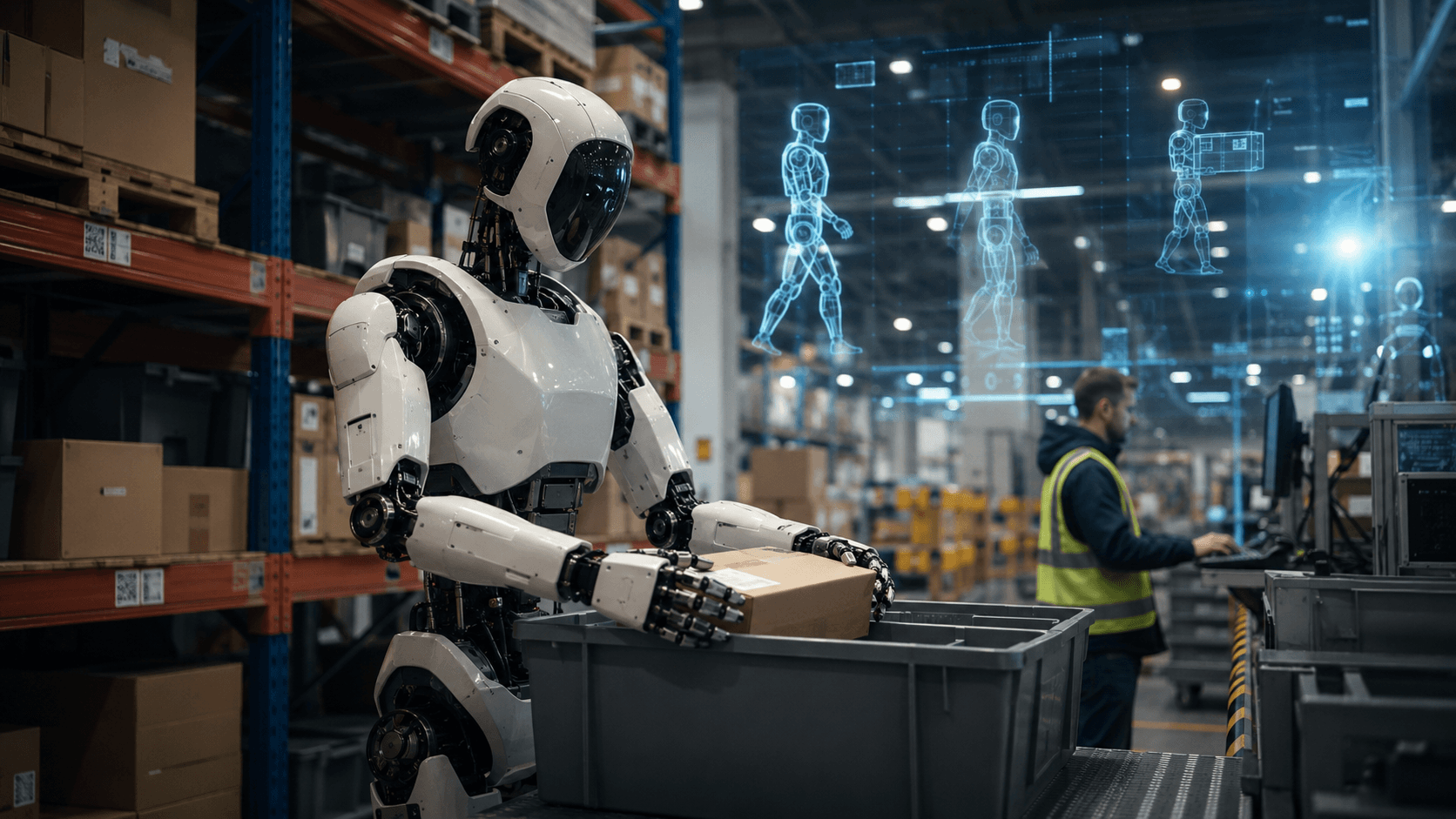
Humanoid robots are making headlines, but how much is real? Explore what is actually deployed in warehouses today, what remains hype, and what operations leaders should watch next.
Every few weeks, a new video makes the rounds: a humanoid robot folding laundry, sorting packages, or racing a warehouse worker through a pick task. The clips are genuinely impressive. They are also, in most cases, not a description of what is actually running in a working warehouse today.
That gap between demonstration and deployment is the central question for any operations leader trying to figure out whether humanoid robots belong in a warehouse automation strategy right now, or whether they belong on a watch list for later.
The honest answer sits in the middle. A small number of humanoid robots are doing real, paid work in real facilities today, but on a narrow set of tasks. Most of what dominates the headlines is still a demo, a pilot, or a claim that has not been independently confirmed. Understanding which is which matters more than picking a side in the hype debate.
Why Humanoid Robots Are Getting So Much Attention Right Now
Three things changed at once. AI models that let robots learn tasks from demonstration data, rather than being hand-coded for every motion, improved faster than most robotics teams expected. Investment followed: Figure AI reached a reported $39 billion valuation in a 2025 funding round, and Tesla has stated plans to build dedicated production lines aiming for volume in the millions of units per year. And manufacturing costs started dropping as component supply chains matured.
Goldman Sachs Research revised its own market outlook upward in 2024, raising its projected global market for humanoid robots to $38 billion by 2035, more than six times its earlier estimate. The same research pointed to unit manufacturing costs falling from a range of roughly $50,000 to $250,000 down to $30,000 to $150,000, a meaningful shift for any operator doing early payback math.
None of that tells you what a robot can do inside your four walls today. For that, it helps to look at what is actually deployed, not what is projected.
What Is Actually Running in Warehouses Right Now
The table below separates confirmed, paid deployments from trials, demos, and programs aimed at other industries entirely.
Table 1: Humanoid Robot Programs and Their Warehouse Status
Snapshot of where major humanoid robot programs stand in logistics and warehouse environments, based on public reporting.
| Assessment Factor | Strong Fit for Automation | Needs Further Assessment |
|---|---|---|
| Daily order volume | 500+ orders/day consistently | Highly variable, seasonal spikes only |
| Fulfillment window | Under 4 hours required by customers | 24+ hours still acceptable to customers |
| SKU profile | Defined, relatively stable catalog | Highly diverse with frequent new additions |
| Facility type | Greenfield or planned major expansion | Legacy brownfield with structural constraints |
| WMS capability | Modern, API-friendly system in place | Older system with limited integration options |
| Labor situation | Consistent shortage or high turnover | Stable, cost-competitive labor available |
What Is Real
The clearest proof point is Agility Robotics' Digit at the GXO-operated Spanx facility. Digit lifts totes and places them on conveyors, a repetitive, physically demanding task that GXO bills as part of a multi-year contract. That is a genuine commercial deployment: a customer is paying for the work, on a defined task, in a live facility.
Agility has also built fleet management software, called Arc, specifically to coordinate multiple Digit units at once rather than relying on one engineer per robot. That kind of infrastructure, unglamorous as it sounds, is usually a better signal of maturity than any single demo video.
Apptronik's Apollo follows a similar logic. It was designed from the outset for warehouse and manufacturing floors, with a modular body and battery packs that can be swapped in the field rather than requiring the robot to sit and charge. That is a practical design choice aimed at real shift patterns, not a stage demo.
What Is Still Hype or Unproven
A lot of what gets the most attention is the least representative of warehouse readiness. Figure AI's package-sorting livestream and its televised race against a human worker generated enormous engagement, but both were staged events built for visibility, not a description of an ongoing production role. Fortune also reported in 2025 that Figure's public description of its BMW partnership may have overstated the actual scope of work underway.
Tesla's Optimus demonstrations have drawn repeated criticism for relying on teleoperation, meaning a human is often guiding the robot's actions remotely rather than the robot acting autonomously. Volume production targets have moved more than once, and as of early 2026 the next hardware generation had not yet been unveiled.
Safety and security questions are also unresolved. A former Figure AI safety officer alleged in a 2025 lawsuit that the company's robots were strong enough to fracture a human skull, a claim that underscores why standards bodies are still working through how to regulate humanoid robots in shared workspaces. Separately, security researchers found exploitable vulnerabilities in Unitree's humanoid and quadruped robots in 2025, a reminder that inexpensive hardware can carry real operational risk.
Rodney Brooks, the roboticist who co-founded iRobot, put the broader skepticism plainly in late 2025, calling the vision of humanoid robots as general-purpose assistants “pure fantasy thinking.” Whether or not that proves right long-term, it is a useful counterweight to vendor demo reels.
Technical Reality Check
Specs matter more than silhouettes. The table below lines up publicly available figures across the programs most relevant to warehouse and logistics use.
Table 2: Humanoid Robot Technical Snapshot
Publicly reported specifications. Figures vary by configuration and are approximate.
| Robot | Payload | Runtime | Approx. Unit Cost |
|---|---|---|---|
| Agility Digit | Up to ~50 lbs (23 kg) | Multi-hour shift with opportunity charging | Delivered as Robot-as-a-Service; unit price not publicly disclosed |
| Apptronik Apollo | ~55 lbs (25 kg) | 4 hours per battery pack, hot-swappable | Not publicly disclosed |
| Boston Dynamics Atlas | Not warehouse-rated (auto assembly focus) | Not publicly disclosed | Not publicly disclosed |
| Tesla Optimus | ~45 lbs (20 kg) planned | Not yet in commercial production | Musk has suggested a consumer price near $30,000, unconfirmed at scale |
| Unitree G1 | Limited, consumer/research-grade | Several hours, varies by task | Approximately $16,000 |
How Humanoid Robots Differ from AMRs and Robotic Arms
It helps to be precise about what a humanoid form factor actually buys an operation. Legs and human-scale arms let a robot work in spaces built for people, climb a step, or reach into a shelf the way a person would. That flexibility is real, but it comes with cost, complexity, and battery limitations that wheeled systems do not carry.
Autonomous mobile robots, which we cover in detail in our breakdown of what AMRs can and cannot do, solve a narrower problem extremely well: moving goods horizontally across a facility, reliably and at scale. Fixed robotic arms solve a different narrow problem: repetitive picking or placing at a single station. Humanoid robots are trying to do a bit of both, in a body shape that adds mechanical complexity mainly to fit human infrastructure.
For most current warehouse bottlenecks, that trade is not yet worth it. A humanoid robot is rarely the fastest or cheapest way to move a pallet, and it is rarely the most reliable way to pick a single SKU. Where it may eventually earn its place is in tasks that require walking, reaching, and general-purpose handling in a space that was never redesigned for robots, which is exactly why interest remains high even as deployment stays limited.
Facilities already running both AMRs and AGVs face a related challenge before a humanoid robot ever enters the mix: keeping one operational picture across robot types. Our guide to managing a mixed fleet of AMRs and AGVs covers what that coordination actually requires.
Table 3: Humanoid Robots vs. AMRs vs. Robotic Arms
Functional comparison across common warehouse automation approaches.
| Factor | Humanoid Robot | AMR | Fixed Robotic Arm |
|---|---|---|---|
| Mobility | Bipedal walking, works in human-scale spaces without modification | Wheeled, requires clear floor paths and adequate aisle width | None, fixed at a single station |
| Manipulation | General-purpose arms and hands, still developing dexterity | None on most transport models; some pair with an arm attachment | High-precision, purpose-built for one task |
| Deployment maturity | Early commercial stage, handful of paid pilots | Established, widely deployed across warehouses | Established, decades of industrial use |
| Approximate cost today | High, often undisclosed or delivered as a service | Moderate, well-documented ROI models exist | Moderate to high depending on application |
| Best-fit task | Human-scale handling in unmodified environments | High-volume horizontal transport | Repetitive picking or placing at a fixed point |
Market Outlook: How Big Could This Actually Get
Goldman Sachs Research's 2024 revision is worth sitting with because it reflects a real, measurable shift rather than sentiment. Analysts raised their 2035 global market estimate to $38 billion, more than six times their prior figure, and increased projected robot shipments fourfold to roughly 1.4 million units over the same period. Their base case still points to industrial use, not consumer households, as the dominant near-term market, with more than 250,000 unit shipments projected by 2030.
That is a meaningful number, but it is also a projection built on assumptions about AI progress and cost curves that have already shifted once and could shift again. Operations leaders should treat it as a directional signal, not a deployment timeline for their own facility.
What to Watch Before Piloting a Humanoid Robot
A few questions cut through vendor pitches faster than anything else. Is the robot doing the demonstrated task autonomously, or is a person guiding it remotely during the parts that matter? What does the contract actually cover: a pilot, a service agreement, or a hardware purchase? What safety certification applies to the specific model in a shared human workspace, not just the robot family in general?
It is also worth asking how the robot's software integrates with an existing WMS or WES, since a robot that cannot talk to warehouse systems is a novelty, not an operations tool. And it is worth discounting any claim that has not appeared outside the vendor's own marketing, particularly around autonomy, since teleoperation is common in current demonstrations and not always disclosed upfront. Our look at what warehouse leaders often underestimate about robotics deployment covers the same discipline applied to more established robot categories.
None of this means humanoid robots should be dismissed. It means they should be evaluated the same way any new automation category is evaluated: against a specific workflow bottleneck, with a realistic view of what is proven versus promised.
How Robotech Pros Can Help
Humanoid robots are moving quickly, and the distance between a compelling video and a working deployment is often larger than it looks. Robotech Pros helps operations teams separate genuine automation opportunities from early-stage technology that is not yet ready for a specific facility, and builds automation roadmaps that account for where a technology actually stands today rather than where a vendor expects it to be in three years.
If your team is trying to decide whether humanoid robots, AMRs, or a mix of both fit your long-term automation strategy, a workflow-focused proof-of-concept is a practical starting point.
Related resources
How Many AMRs Do You Actually Need? A Guide to Throughput Modeling
Most AMR fleet sizes are guessed before anyone counts the moves. This guide walks through the four-step throughput model that replaces the guess, and explains why doubling throughput takes more than double the robots.
Robot Charging Infrastructure: Battery Strategy, Opportunity Charging, and Floor Space Planning
Charging is usually treated as an electrical question and handed to an electrician. The harder question is how much productive floor space the dock bank consumes, and how much of the fleet sits parked when throughput pea
How Racking, Aisle Widths, and Mezzanines Limit Your Automation Options
Most automation shortlists are decided by the building, not the vendor. A practical look at how rack configuration, clear aisle width, and mezzanine design rule options in or out, and what to measure before you invite an