Warehouse Automation
Same-Day Delivery Expectations Are Reshaping Warehouse Design. Here Is How Robotics Fits In
Jul 4, 2026 · 14 min read · Robotech Pros
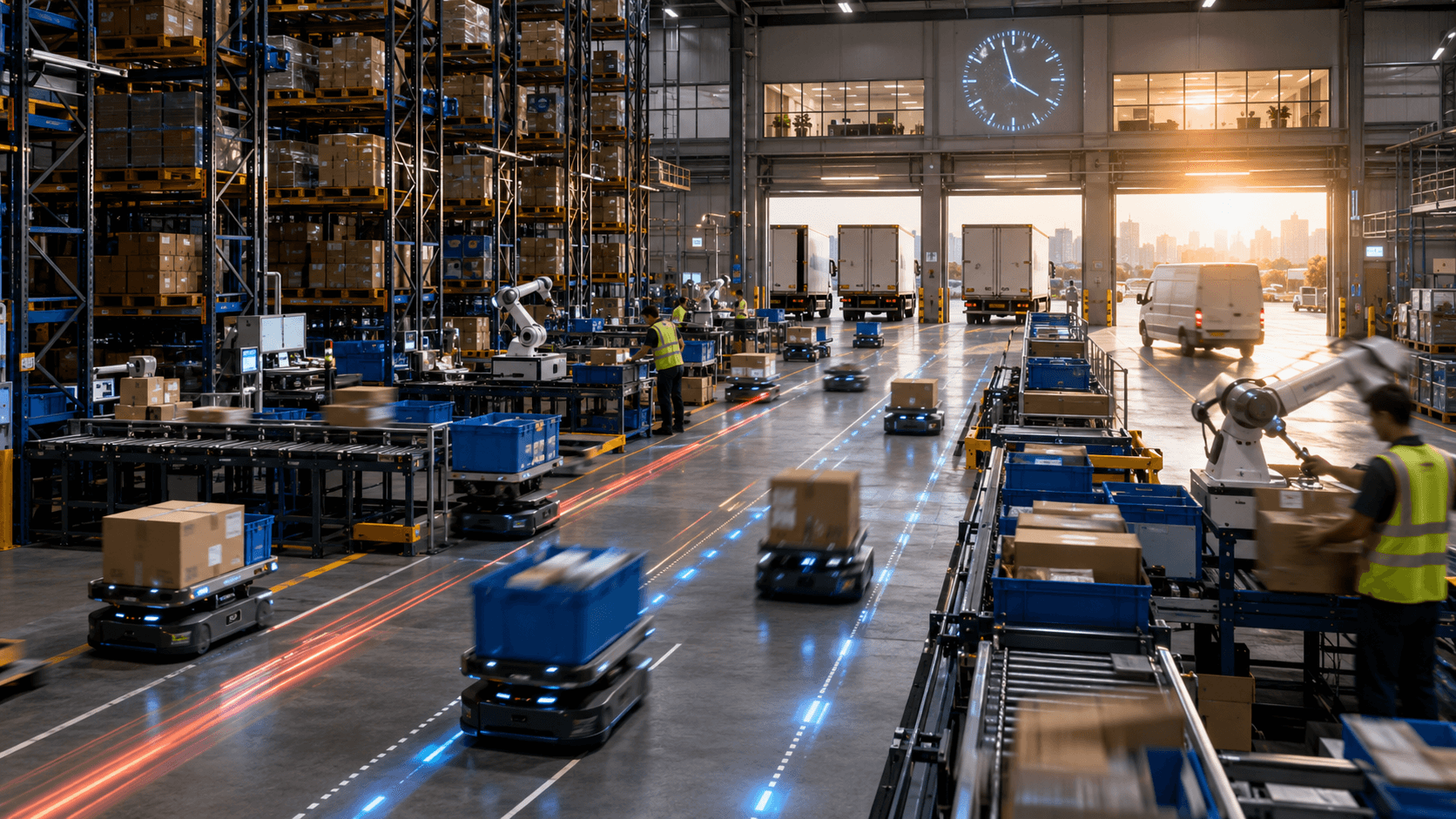
Same-day delivery is reshaping warehouse design. Discover how robotics, AMRs, AI, and goods-to-person systems help warehouses increase speed, efficiency, and fulfillment capacity.
Same-day delivery is no longer a premium service for a few high-margin retailers. It has become a baseline expectation in many product categories, and the operations teams responsible for making it happen are discovering that warehouse models built for 24 to 72-hour fulfillment do not hold up when the window closes to four hours or less.
The pressure is not theoretical. Major retailers and logistics providers are already responding. Walmart committed over $1 billion to supply chain automation with micro-fulfillment centers embedded in existing stores. DSV earmarked $50 million for AMR deployments across European sites. Amazon deployed its one-millionth robot in July 2025 while simultaneously managing more than 350 million active SKUs under same-day commitments in major metros.
For operations teams evaluating where automation fits into their fulfillment strategy, the relevant question is not whether same-day is coming. It is whether their current warehouse design can support it at all, and if not, what has to change.
Why Traditional Warehouse Design Does Not Scale for Same-Day
The fulfillment infrastructure built over the past 20 years was optimized for a different constraint set. Large suburban distribution centers made sense when two-day shipping was standard. The emphasis was on storage density and batch-picking efficiency across long shifts. The underlying assumption was that there was always enough time to work through a queue.
Same-day delivery breaks that assumption. When outbound cutoff windows are measured in hours rather than days, every inefficiency in the pick-to-ship sequence becomes critical. A picker traveling 400 meters to retrieve an item, a sortation queue that processes batch orders every two hours, or a staging area that cannot handle spike volumes on demand. All of these create problems that manual labor adjustments cannot reliably solve.
The warehouse itself has to be redesigned around the new constraint. That means rethinking where inventory sits, how pick zones are structured, how orders are prioritized in real time, and how outbound sortation keeps pace with dispatch schedules. Robotics does not just speed up an existing process. In many cases, it replaces the process design entirely.
Table 1: How Same-Day Delivery Changes Warehouse Design Requirements
| Design Factor | Traditional Fulfillment (24–72 hr) | Same-Day Fulfillment (Under 4 hr) |
|---|---|---|
| Fulfillment window | 24 to 72 hours | Under 4 hours in major metros |
| Facility location | Large suburban distribution centers | Urban micro-fulfillment nodes near consumers |
| Storage priority | Maximize total volume | Position fast-moving SKUs near pick zones |
| Pick path design | Human-optimized aisle layout | Robot-optimized traffic lanes and zones |
| Peak volume handling | Manual flex staffing | Automated elastic capacity |
| Sortation timing | End-of-day or batch processing | Continuous real-time sortation |
The Four Technologies Driving Same-Day Capability
No single robotics system solves the same-day fulfillment problem on its own. The operations that deliver reliably at this speed generally combine several technologies, each addressing a different constraint in the pick-to-ship sequence.
Autonomous Mobile Robots (AMRs)
AMRs handle goods movement across the warehouse floor. They eliminate the walking time that accounts for the largest portion of time in a manual pick operation, and they scale in ways that human staffing cannot. During peak periods, AMR fleets can triple order-processing speed without requiring advance scheduling or training cycles. Their flexibility also matters specifically for same-day: routes and task priorities can be updated in real time based on what orders are currently queued.
AMRs perform best in large-footprint facilities with high order volume and relatively stable SKU profiles. In environments with significant floor travel and clearly defined pick zones, the throughput impact is measurable within the first weeks of deployment.
Goods-to-Person (GTP) Systems
Goods-to-person systems invert the traditional pick process. Instead of sending a picker to find an item, the system brings the item to a stationary picker. This can be achieved through cube-based automated storage and retrieval systems (AS/RS), shuttle systems, or vertical lift modules depending on facility constraints and SKU density.
The operational impact on same-day fulfillment is substantial. GTP systems cut worker walk distances by up to 75 percent and reduce the average pick span to around 30 seconds. In urban micro-fulfillment centers where floor space is at a premium, cube-based AS/RS also lifts storage density up to fourfold compared to conventional racking, allowing more inventory to be positioned closer to consumers without requiring large facilities.
Automated Sortation
Once items are picked, they need to be assigned to the correct outbound carrier, delivery zone, or route. In a manual environment, this step frequently creates a bottleneck near end-of-shift. Automated sortation systems process orders continuously rather than in batches, which is essential for same-day operations because there is no slack time between pick completion and dispatch.
Modern sortation systems can also process returns the same day they arrive, reinserting inventory into the outbound flow and recovering value that would otherwise sit idle in a returns queue.
AI-Powered Vision Picking
For operations with high SKU diversity or irregular item shapes, robotic picking arms equipped with AI vision address one of the most persistent limitations of earlier automation. Current systems achieve approximately 99.5 percent grasp accuracy across transparent, deformable, and reflective items that previously required human handling. Category onboarding that once took several weeks now takes hours, which matters when SKU catalogs change frequently alongside product launches or client additions.
Table 2: Robotics Technologies for Same-Day Fulfillment
| Technology | Primary Function | Operational Impact | Best-Fit Use Case |
|---|---|---|---|
| Autonomous Mobile Robots (AMRs) | Goods transport across warehouse floor | Triple order-processing speed at peak | High-volume, large-footprint DCs |
| Goods-to-Person (AS/RS, shuttles) | Bring inventory to stationary pickers | 75% reduction in walk distance; ~30-second pick spans | Urban micro-fulfillment, dense storage |
| Automated Sortation | Route and classify outbound orders | Continuous throughput; same-day returns processing | High-volume e-commerce, parcel hubs |
| AI Vision Picking | Robotic item picking for diverse SKUs | ~99.5% grasp accuracy on complex or irregular items | Multi-SKU environments with difficult items |
Greenfield vs. Brownfield: The Design Decision That Shapes Everything
For operations evaluating automation investment, the greenfield versus brownfield question is the most consequential decision to resolve before anything else. Retrofitting an existing facility costs 60 to 80 percent more than integrating automation into a new site from the start. Legacy aisles, mezzanines, and electrical infrastructure rarely align with what automated systems require, and installation downtime in a live operation carries its own revenue cost.
That does not make brownfield retrofits unviable. Operations teams that phase rollouts carefully, maintaining active picking lanes during installation and using modular system designs that fit inside existing rack structures, can execute brownfield transitions without significant disruption. The key is sequencing realistically and validating integration points before scaling across the facility.
Greenfield micro-fulfillment centers purpose-built for same-day represent a different planning conversation. When the facility layout can be designed around the robotic system from the beginning, storage density, pick zone configuration, and traffic flow can all be optimized together. The capital requirement is higher upfront, but the operational performance ceiling is also considerably higher.
Table 3: Greenfield vs. Brownfield for Same-Day Automation
| Factor | Greenfield Build | Brownfield Retrofit |
|---|---|---|
| Design flexibility | High: layout built for robotics from the start | Limited by existing aisles, mezzanines, and electrical infrastructure |
| Relative cost | Baseline | 60–80% higher than comparable greenfield |
| Implementation approach | Full system design before build begins | Phased rollout to maintain live operations throughout |
| Storage density potential | Optimize cube from the start (up to 4× increase with AS/RS) | Modular pods can recover density within existing rack structures |
| Integration complexity | Lower: modern systems by default | Higher: legacy WMS and infrastructure challenges |
| Best suited for | New facilities, urban micro-DCs | Existing DCs with clear throughput bottlenecks |
What Operations Teams Frequently Misjudge
The most common mistake is treating robotics as a drop-in replacement for labor without first addressing workflow design. Robots are fast, but they are also dependent on how well the surrounding systems communicate. If the orchestration software cannot prioritize same-day orders ahead of standard orders in real time, or if the WMS cannot convey order urgency to the fleet management layer, the throughput advantage disappears in practice.
The second frequent issue is underestimating integration timelines. A same-day fulfillment operation relies on tight coordination between order management, inventory, WMS, and the robotics fleet. When those systems do not share data cleanly, exceptions accumulate. In a four-hour fulfillment window, exceptions are not just errors. They are orders that miss dispatch.
A phased implementation approach addresses both risks. Starting with one automated zone and validating software integration before expanding gives operations teams a realistic picture of what the system actually delivers under live conditions, not just what a demonstration environment showed.
The Market Numbers Behind the Investment
The capital flowing into this space reflects how seriously operations leaders are taking the same-day transition. The global warehouse robotics market is valued at approximately $10.96 billion in 2026 and is forecast to reach $24.55 billion by 2031, growing at a 17.5 percent compound annual rate. Mobile robots are expanding fastest within that figure at an 18 percent CAGR, driven precisely by the flexible, scalable floor-level automation that same-day fulfillment requires. Picking and sortation systems are growing at a similar rate as operations prioritize the stages most directly tied to fulfillment speed.
Labor dynamics reinforce the case. Vacancy rates in fulfillment operations exceed 8 percent in many markets, with annual turnover close to 100 percent in physically demanding roles. Robotics reduces labor minutes per order by up to 60 percent, which matters both for cost management and for operational stability in a hiring environment where consistent manual throughput is increasingly difficult to maintain.
Assessing Whether Your Operation Is Ready
The right entry point varies considerably by facility type, current throughput, and capital position. Robotics-as-a-service models have made automation more accessible for mid-sized operations by converting upfront hardware costs into variable per-pick fees. This lowers the commitment threshold for initial deployment and aligns costs with actual throughput during the early phase of a same-day program when volumes may not yet be predictable.
For large e-commerce operators already managing high daily volumes, the conversation is usually about which technology combination addresses the most critical throughput constraint first, and how to sequence expansion without disrupting live operations. For 3PLs, multi-client environments add a layer of planning that standard deployment guides do not cover, particularly around SKU segmentation and order prioritization across clients with different service level requirements.
Table 4: Same-Day Automation Readiness Assessment
| Assessment Factor | Strong Fit for Automation | Needs Further Assessment |
|---|---|---|
| Daily order volume | 500+ orders/day consistently | Highly variable, seasonal spikes only |
| Fulfillment window | Under 4 hours required by customers | 24+ hours still acceptable to customers |
| SKU profile | Defined, relatively stable catalog | Highly diverse with frequent new additions |
| Facility type | Greenfield or planned major expansion | Legacy brownfield with structural constraints |
| WMS capability | Modern, API-friendly system in place | Older system with limited integration options |
| Labor situation | Consistent shortage or high turnover | Stable, cost-competitive labor available |
The common thread across all of these operations is that same-day delivery at scale is not achievable through staffing adjustments alone. The warehouse has to be designed to operate at that speed, and robotics is what makes that design viable in practice.
How Robotech Pros Supports Same-Day Deployment
Robotech Pros works with warehouse operators, 3PLs, and e-commerce fulfillment teams to assess automation readiness, select the right technology combination, and support deployment through integration and go-live. If your operation is evaluating same-day capability or looking to expand current automation, we can help you build a practical roadmap based on your actual facility, order profile, and timeline. Contact us at contact@robotechpros.com to start with a workflow assessment.
Related resources
How Many AMRs Do You Actually Need? A Guide to Throughput Modeling
Most AMR fleet sizes are guessed before anyone counts the moves. This guide walks through the four-step throughput model that replaces the guess, and explains why doubling throughput takes more than double the robots.
Robot Charging Infrastructure: Battery Strategy, Opportunity Charging, and Floor Space Planning
Charging is usually treated as an electrical question and handed to an electrician. The harder question is how much productive floor space the dock bank consumes, and how much of the fleet sits parked when throughput pea
How Racking, Aisle Widths, and Mezzanines Limit Your Automation Options
Most automation shortlists are decided by the building, not the vendor. A practical look at how rack configuration, clear aisle width, and mezzanine design rule options in or out, and what to measure before you invite an